A nation under our feet : Black political struggles in the rural South, from slavery to the great migration by Hahn Steven 1951-
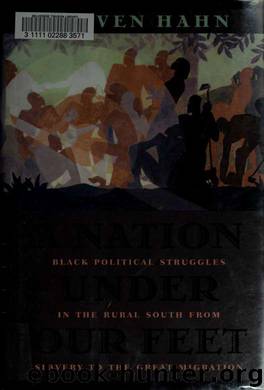
Author:Hahn, Steven, 1951-
Language: eng
Format: epub
Tags: African Americans, African Americans, African Americans, Noirs américains, Noirs américains, Noirs américains, Negers, Politieke activiteit, Politieke cultuur, Sklaverei, Bürgerrechtsbewegung
Publisher: Cambridge, Mass. : Belknap Press of Harvard University Press
Published: 2003-03-28T16:00:00+00:00
religious bodies, and all other societies" to choose delegates according to the following plan of "apportionment": "Any organized religious body, one delegate; any Benevolent Society, one delegate; any Secret organization, one delegate; any Plantation with 50 persons, one delegate; any organization composed exclusively of Negro people, one delegate." 1
The convention call simultaneously expressed aspirations held by most African Americans in the southern countryside and identified the social bases and parameters of their politics. It thus draws our attention to a field of political activity that can easily be overlooked, though only at great peril. Indeed, by the late 1870s emigrationist sentiment had not only gained a wide hearing but had also constituted a substantial movement among black laborers, chiefly in the cotton South—a movement that belies the notion that Redemption set black politics into full-scale retreat. What we can see, instead, is a reconstitution of the relationship between the electoral and other arenas of political practice, and the emergence of projects and conflicts that would shape the social and political landscape for the next three decades. 2
Henry Adams's education suggests how this might have been so, mapping as it did many of the intellectual and political thoroughfares that eventuated in what may be called grassroots emigrationism. Born a slave in rural Newton County, Georgia, in 1843, Adams and his family were taken some seven years later to the Louisiana parish of De Soto, bordering northeast Texas, where they worked on plantations until learning of emancipation in June 1865. Owing perhaps to his being hired out during the last few years of slavery and to the influence of his father, who preached the gospel in the face of white intimidation, Adams brought into freedom some personal property together with an extremely independent disposition. "I feared God but not man," he claimed to have told a local planter who had warned him of the inveterate hostility of poor white folk. And refusing to sign a labor contract, he took to the roads of De Soto and neighboring Caddo Parish, usually heading to and from Shreveport. 3
Harassed, robbed, and beaten as he tried to fashion a livelihood and having witnessed an array of other "outrages" inflicted on freed-people, Adams decided to join the U.S. Army in September 1866. For the next three years, he served in three units and rose to the rank of quartermaster-sergeant, all the while imbibing powerful and enduring
Download
This site does not store any files on its server. We only index and link to content provided by other sites. Please contact the content providers to delete copyright contents if any and email us, we'll remove relevant links or contents immediately.
| African-American Studies | Asian American Studies |
| Disabled | Ethnic Studies |
| Hispanic American Studies | LGBT |
| Minority Studies | Native American Studies |
Cecilia; Or, Memoirs of an Heiress — Volume 1 by Fanny Burney(32527)
Cecilia; Or, Memoirs of an Heiress — Volume 2 by Fanny Burney(31928)
Cecilia; Or, Memoirs of an Heiress — Volume 3 by Fanny Burney(31916)
The Great Music City by Andrea Baker(31900)
We're Going to Need More Wine by Gabrielle Union(19020)
All the Missing Girls by Megan Miranda(15890)
Pimp by Iceberg Slim(14464)
Bombshells: Glamour Girls of a Lifetime by Sullivan Steve(14038)
For the Love of Europe by Rick Steves(13819)
Talking to Strangers by Malcolm Gladwell(13332)
Norse Mythology by Gaiman Neil(13317)
Fifty Shades Freed by E L James(13216)
Mindhunter: Inside the FBI's Elite Serial Crime Unit by John E. Douglas & Mark Olshaker(9298)
Crazy Rich Asians by Kevin Kwan(9262)
The Lost Art of Listening by Michael P. Nichols(7476)
Enlightenment Now: The Case for Reason, Science, Humanism, and Progress by Steven Pinker(7288)
The Four Agreements by Don Miguel Ruiz(6728)
Bad Blood by John Carreyrou(6600)
Weapons of Math Destruction by Cathy O'Neil(6248)
